
1. Executive Summary
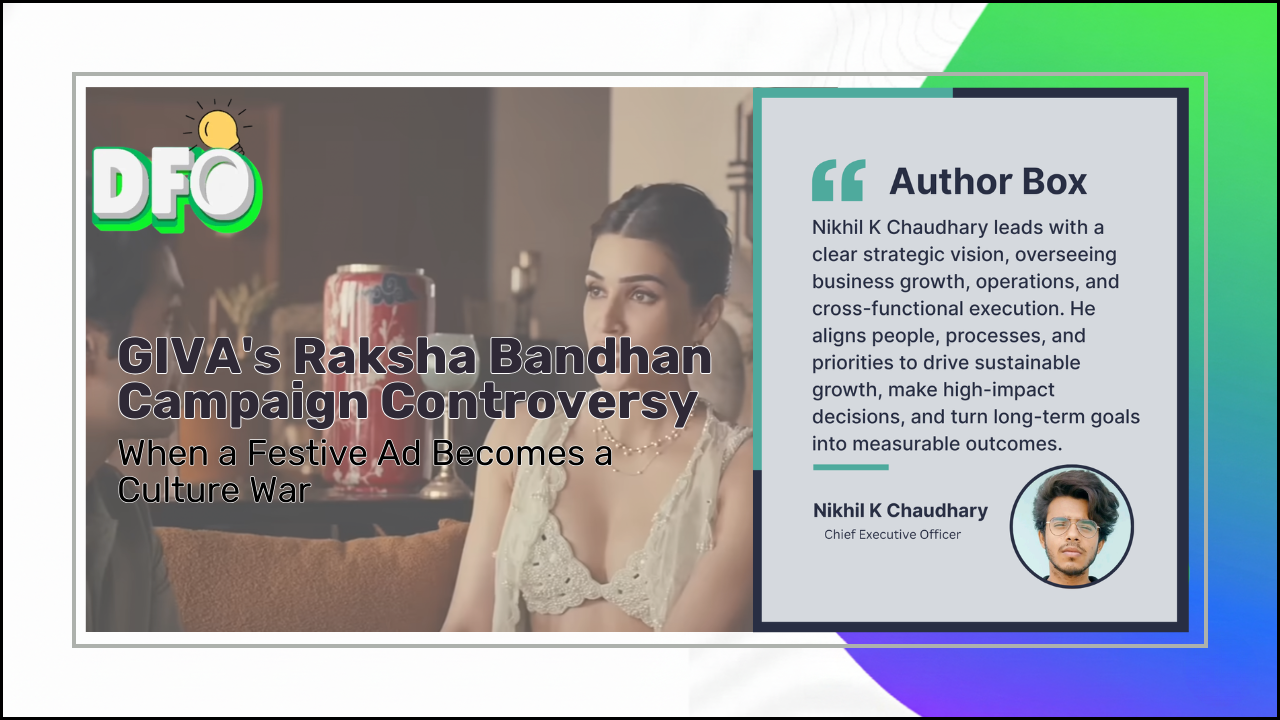
In August 2026, jewelry brand GIVA was forced to withdraw a Raksha Bandhan advertisement featuring Bollywood actor Kriti Sanon after it triggered a nationwide debate around clothing, culture, and moral policing. What started as a festive product campaign became a flashpoint involving a rival Bollywood actor-turned-politician, a national opposition leader, and days of sustained social media conflict, ultimately ending in the brand pulling the ad “out of respect.”
This case study breaks down the campaign, the controversy, the key actors, and the marketing lessons for brands building culturally rooted festive campaigns in India.
2. Background: The Campaign
- Brand: GIVA, a direct-to-consumer jewelry brand known for festive and gifting-led campaigns.
- Talent: Kriti Sanon, a mainstream Bollywood actor.
- Concept: The campaign was built around Raksha Bandhan, the Indian festival celebrating sibling bonds, where sisters tie a rakhi (sacred thread) on their brothers’ wrists. GIVA’s creative twist extended the ritual to pets, showing Kriti tying a rakhi to her dog as well as to her brother, and positioning pets as part of the family.
- Styling: Kriti appeared in an Indo-Western outfit, described across reports as an ivory ethnic ensemble with a bralette-style blouse, cape, and draped skirt/lehenga.
- Precedent: This event was not GIVA’s first attempt at a pet-inclusive rakhi narrative. The brand had run a similar theme in 2025 with actor Anushka Sharma in a campaign called “Ties of Love,” which also showed her tying a rakhi to her pet dog. That earlier version did not generate comparable backlash, a useful comparison point for what changed this time.
3. Timeline of Events
| Date / Stage | Event |
|---|---|
| Campaign launch | GIVA’s Raksha Bandhan ad featuring Kriti Sanon goes live across the brand’s digital and social channels. |
| Initial reactions | A section of social media users criticizes two elements: (1) Kriti’s outfit as unsuitable for a “traditional” festival and (2) the choice to include a pet rakhi within the ritual, which some felt diluted the sibling-centric meaning of the festival. |
| Aug 24, 2026 | Actor and BJP MP Kangana Ranaut posts an Instagram Story questioning the outfit, comparing it to a bikini or undergarments, and asking why, given how many clothing options exist for women today, this look was chosen for a rakhi scene. She closes the post, calling the ad “intentionally creepy.” |
| Aug 25, 2026 (Tuesday) | Kriti Sanon responds directly on Instagram. She argues that the meaning of festivals lies in emotion and intent, not clothing, defends including her dogs as family, and pointedly asks when society will stop dictating what women should wear, adding that culture lives in her heart, not in her neckline. |
| Same window | Rahul Gandhi, Leader of the Opposition in the Lok Sabha, publicly backs Kriti’s position, framing what a woman wears, does, or where she goes as her own choice, pulling the controversy into national political discourse. Kriti’s sister, actor Nupur Sanon, also weighs in during this period. |
| Aug 26, 2026 | GIVA issues an official statement and withdraws the advertisement from all media. |
4. The Brand’s Statement (Key Elements)
GIVA’s withdrawal statement made three distinct moves, which are worth studying as a template for crisis response copy:
- Reaffirmed cultural respect. The brand said it holds the highest regard and deep respect for Indian culture, traditions, and festivals.
- Explained intent without admitting fault. GIVA said its goal was to celebrate festive togetherness and extend that spirit to pets, and that any hurt sentiment was inadvertent and not its intent at all.
- The withdrawal was announced with a soft, non-confrontational close. The ad was pulled out of respect, followed by a generic festive well-wish.
The statement does not concede that the ad, the outfit, or the pet-rakhi concept was inappropriate. It frames the decision entirely around impact (hurt sentiment) rather than fault (wrongdoing), a classic reputation-management distinction that avoids setting a precedent of guilt while still de-escalating the situation.
5. The Two Sides of the Debate
Critics’ position:
- Raksha Bandhan is a culturally and religiously significant festival; advertising imagery tied to it should reflect traditional sensibilities.
- The outfit (bralette-style blouse, deep neckline) was seen by critics as more suited to a fashion editorial than a festival built around sibling protection.
- Some objected specifically to the pet-rakhi element diluting or trivializing the core meaning of the ritual.
Kriti Sanon’s/Supporters’ position:
- A woman’s clothing is not a valid measure of her respect for tradition or culture.
- Modern, Indo-Western festive wear is increasingly normal and does not inherently conflict with cultural sentiment.
- Pets are legitimately considered family members by many urban Indian households, making the pet-rakhi narrative a reasonable, if novel, creative extension.
- The broader criticism reflects a pattern of policing women’s clothing choices under the guise of culture.
The controversy therefore evolved through three distinct layers:
- Product/creative layer: Was the pet-rakhi concept a good creative idea?
- Styling layer: Was the outfit appropriate for the festival context?
- Socio-political layer: women’s autonomy over clothing choices, amplified by a celebrity feud (Ranaut vs. Sanon) and partisan political commentary (Gandhi’s intervention).
It was the escalation from layer 2 to layer 3, via Kangana Ranaut’s intervention and then Rahul Gandhi’s, that transformed a routine ad-styling complaint into a national news story.
6. Why This Escalated: Key Amplification Factors
- Celebrity-vs-celebrity conflict. Kangana Ranaut has a long public history of clashing with Bollywood peers over styling, culture, and conduct. Her involvement guaranteed mainstream entertainment media pickup independent of the ad itself.
- Politicization. Once Rahul Gandhi weighed in, the story crossed from entertainment/marketing news into political and general news coverage, multiplying its reach and changing the audience from consumers to the general public and political commentators.
- Festival timing. Raksha Bandhan carries strong sentimental and religious weight in India, making brands more vulnerable to “cultural disrespect” narratives than with a generic seasonal campaign.
- Precedent contrast. Because GIVA had run a near-identical pet-rakhi concept with Anushka Sharma in 2025 without major backlash, commentators could frame this year’s reaction as being driven more by Kriti’s styling than the concept itself, intensifying the “outfit vs. culture” framing over the “pets vs. tradition” framing.
- Amplification through rebuttal. Kriti’s own response, while principled, kept the story alive for another news cycle rather than the controversy fading after Ranaut’s initial post.
7. Marketing & Brand Safety Lessons
1. Reach and controversy are not the same as positive equity. The campaign achieved enormous visibility, but that visibility became reputational risk rather than brand-building attention. For festive/cultural campaigns particularly, virality driven by offense is a liability, not a KPI.
2. Festival campaigns sit closer to “cultural speech” than generic advertising. Brands tying creative concepts to religious or culturally significant festivals should stress-test styling and creative choices against a wider range of sensitivities than a typical seasonal sale campaign, even when a similar idea worked previously with a different face attached to it.
3. Precedent doesn’t guarantee immunity. The fact that a near-identical concept succeeded with another celebrity a year earlier didn’t protect GIVA this time. Public reaction to identical creative ideas can shift year to year, especially once a public figure with a large, mobilized following (like Ranaut) chooses to comment.
4. Talent statements can extend a crisis timeline. Kriti Sanon’s response was well-received by her supporters, but from a pure crisis-management lens, each additional public statement (her post, Ranaut’s post, Gandhi’s post) added a fresh news cycle. Brands need to align with talent on whether direct rebuttal or brand-level silence better serves de-escalation.
5. Withdrawal statements should separate “impact” from “fault.” GIVA’s statement is a useful model: it acknowledged the effect (hurt sentiment) without admitting the substance of the criticism (that the ad was wrong). This avoids legal/reputational admission while still allowing the brand to visibly de-escalate.
6. Political amplification is largely uncontrollable. Once a story crosses into national politics, brand-level statements have limited power to shape the narrative. The most effective lever remaining is speed of withdrawal; GIVA acted within roughly two days of the controversy peaking.
Note: This is a fast-moving, recent story (last 24 to 48 hours as of publication). Some figures, quotes, and exact dates may be updated or clarified in subsequent reporting.